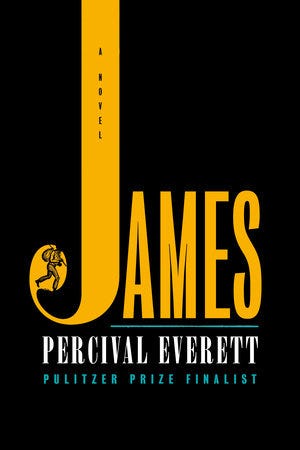
Percival Everett's Code-Switching
Much of the brilliance of Everett's novel James lies in the language

Percival Everett certainly doesn’t need me to recommend his work. His novel Erasure was adapted into the multi-award (including an Oscar for Best Adapted Screen Play) winning film American Fiction. Known for his irony and his satirical explorations of racism and race through genres such as Westerns and Crime novels, he is also a terrific story teller.
He does it again, and delightfully, in James. This retelling of Mark Twain’s Huckleberry Finn from the perspective Finn’s enslaved friend Jim, presents Jim as James, an erudite and well-read man who carries on imaginary arguments with the likes of Enlightenment philosophers John Locke and Voltaire. He’s also (apparently like Everett himself, whose hobbies include woodworking and fly fishing) good with his hands and schooled in survival skills, which come in handy during the course of this tightly paced novel with its numerous plot twists—and one terrific reveal.
But the real genius of the novel lies in the code-switching, the way that James and other enslaved people talk to one another when white people aren’t around. Not at all the slang and jive talk one might expect—in their private world, these characters speak with elevated diction and complex vocabulary. It’s only when forced to comply with the perspective of people who insist they are inferior that they use the kinds of dialect employed by the great Mark Twain himself in his depiction of Jim.
As I said, Everett doesn’t need me to recommend his work, but I do so anyway.